Hanoi to Luang Prabang overland
Our experience of a character-building journey
Preparation
If you need a visa to enter Laos, you can’t currently get one at the Tay Trang/Panghok overland border, but check the latest situation at https://immigration.gov.la We found it easy to get a visa in person in Hanoi at the Laos embassy, where it is processed the same day. (We arrived at 09:30 and picked up at 15:30). It costs $40 and you need a passport photo.
Breaking the journey at Dien Bien Phu is a good option. There is a moving and impressive war memorial in town and the Vietnamese Command HQ in caves outside the town makes an interesting trip by taxi.
Planning in connections is risky, as road conditions are poor and journey times are always longer than advertised.
However, although the bus from Dien Bien Phu goes all the way to Luang Prabang, changing to the last train of the day at Oudomxay (also called Muang Xai) is worth the risk. It will save 3 more hours after over 9 hours on Laotian roads. You will want to buy your Laos train e-ticket in advance via a travel website or the Laos China Railway (LCR) app, as bookings open 3 days in advance and the trains do book out rapidly.
Payments can be made widely by QR code in Laos, so you may wish to install the Loca app. (It’s the same app as for taxis in Vientiane, like Uber) .Although registration normally requires a local Lao telephone number for the OTP SMS, you can contact customer service by WhatsApp and they can help you register. The exchange rate is poor, but it’s good to have this as a backup to cash for payments, as cards are only accepted in upmarket places.
From Hanoi to Dien Bien Phu:
If, like us, you don’t want to take an overnight bus to Dien Bien Phu, options (and information) are limited. We would recommend going from My Dinh bus station in Hanoi. There is one through day bus per day (and several overnight ones) – or there are many to Son La and up to 7pm you can easily change at Son La for the last leg.
Our hotel arranged us a place on a 07:30 limousine bus from Yen Nghia bus station – but the bus didn’t turn up. Not knowing there were options from My Dinh, we booked ourselves on the next advertised option from Yen Nghia – a 10:30 departure.
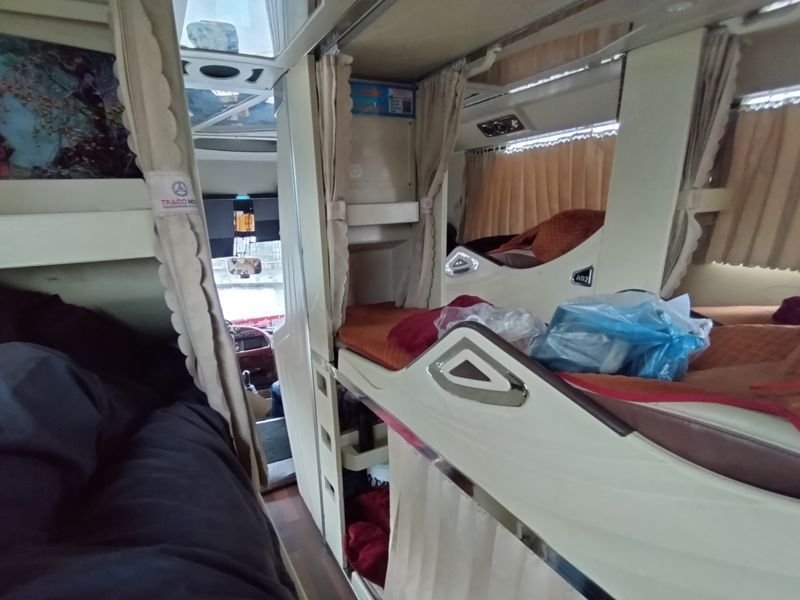
The bus was one of the sleeper style but the road is ok, so it was reasonably comfortable, although slow progress. When we finally arrived in Son La at 6pm, we were told the bus was terminating there and we were transferred to a minibus for the last leg of the ride.
After Son La, the roads become increasingly poor and narrow. Plus the minibus stops multiple times to make deliveries. Definitely not an express service, but it got us there in one piece at 11pm. Finally.
We paid 360,000VND each for the first sector and 150,000VND each for the last leg.
On from Dien Bien Phu
Before you leave Dien Bien, we recommend you buy some Lao currency, as you won’t see an ATM until Luang Prabang. Although Laotian kips are not technically available outside the country, ask around and you will find somewhere – probably a jewellery shop – who will have some. Their exchange rates are fair.
You can exchange any remaining Vietnamese currency at the border with the Vietnamese border guards who will give you kip in exchange. You will need 10,000 kip at the Laos border for the stamp in your passport – everyone, even the locals, pays – as well as 50,000 kip for the tuk-tuk to get you to the train station at Oudomxay from where the bus drops you off.
Use a waterproof cover for your bags if there’s a chance of rain – they go on the roof of the bus and are not necessarily covered by the tarpaulin.
Phone coverage is very poor on the Laos side of the border.
Be prepared for some hard travelling on poor roads – we achieved an average speed of 30km/h on the Laos side of the border. As is customary in Vietnam, we had reserved our bus place via the hotel reception, and we were picked up early (07:00) in the weirdest bus. The front seats were against the ground, giving nowhere to put your legs, and the back row of seats were basically sitting beds with a flat area to stretch legs. In all, there were only a dozen proper seats. There were way more people in the bus than there were places – so some ended up sitting doubled up uncomfortably in the raised flat area.
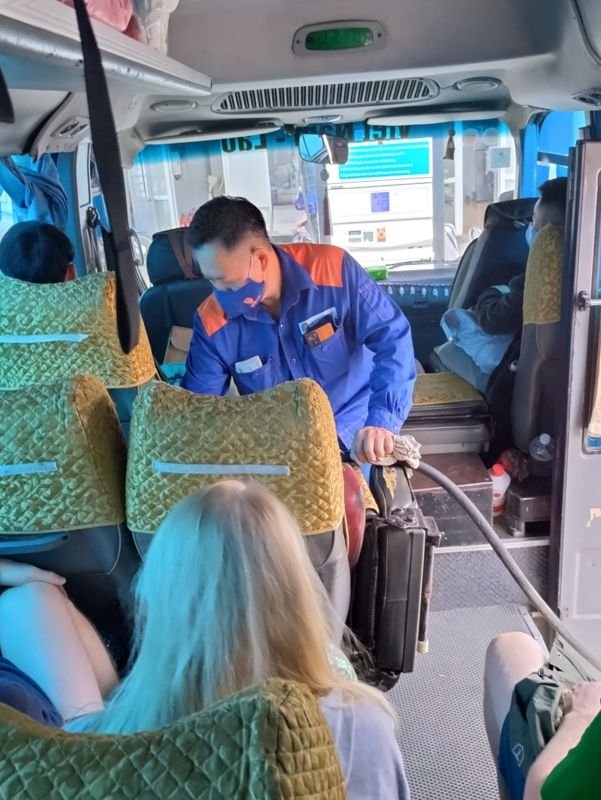
The border crossing was relatively straightforward (especially compared to some Balkan crossings we have done).
Once across the border the first stretch of road is very smooth (yay!) but it doesn’t last. It’s a long and winding road full of potholes. Very beautiful though. It’s also very sparsely populated after Vietnam. Lunch was at the first main village, Muang Khua, which looks to be a few houses and a shack restaurant along the road, although it has a population of a few thousand. It’s another world from Vietnam – noodle soup and pot noodles abound and not much in the way of snacks…. Or people. Payment is either in kip or by QR code – but without stable internet on the road we hadn’t been able to register our Loca payment app.
As we continued we watched the clock tick down for our train connection from Udomxay at 17:18. (We were not keen to stay on the boneshaker bus for another 3 hours to Luang Prabang.) Arriving in the outskirts of town, there was one tuk-tuk available to take us to the station… and he was not in a hurry, stopping to tout for other passengers on the way!
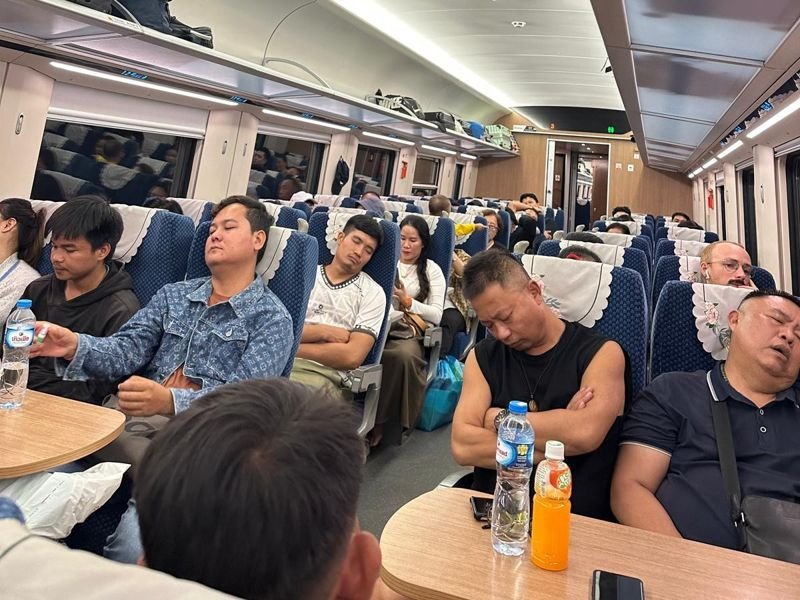
The contrast arriving at the station is huge. It’s a massive glamorous building with airport style security to enter. There was only a small queue for getting in, so in the end we were easily there in time.